Introduction: The Transformation of AI in Modern Work
Artificial intelligence has moved far beyond the era when it was considered a playful innovation or a futuristic idea that lived inside labs and tech experiments.
In today’s workplace, AI has slipped into the center of daily workflows, turning from a novelty tool into a practical necessity that millions of employees rely on to manage time, reduce workload, and improve decision-making.
This evolution has been subtle yet incredibly powerful, quietly reshaping how businesses operate and how individuals perform their everyday tasks. What once felt like an optional add-on has now become something many people cannot imagine working without.
As organizations demand faster responses, smarter insights, and more efficient operations, AI tools have stepped into roles that support nearly every professional function.
Teams no longer view AI as an experimental technology—they see it as an essential ally that helps them handle complexity, speed up processes, and maintain consistent accuracy across workflows. The transition has brought a new era where AI is not only a support system but also a partner in productivity, creativity, and strategic growth.

AI as a Productivity Engine: Reducing Workload and Increasing Speed
One of the strongest reasons AI has become a workplace essential is its ability to dramatically improve productivity. Professionals across industries report significant time savings when using AI for summarizing documents, drafting reports, analyzing data, and performing repetitive administrative tasks.
Instead of spending hours sorting through long emails, writing proposals from scratch, or organizing disorganized information, employees now rely on AI to handle these steps with speed and precision. This shift allows workers to dedicate more energy to activities that require critical thinking and human creativity.
The biggest advantage lies in consistency. Human energy fluctuates during the day, but AI systems operate with a steady pace and uninterrupted focus.
Whether someone needs a quick summary at the start of the morning or a detailed breakdown late at night, AI tools deliver prompt responses that help move tasks forward. This reliability has built trust between employees and AI, making these tools an everyday companion rather than an occasional novelty.
AI as a Digital Coworker: Supporting Daily Team Operations
Another major force behind AI’s rise is its ability to function like a “digital coworker” that assists teams in many different roles. Instead of acting as a simple question-answering system, modern AI tools understand context, recognize patterns, and provide suggestions that guide employees through complex tasks.

Team members now depend on AI not only for writing or editing but also for planning meetings, organizing projects, improving workflow efficiency, and generating performance insights.
These tools have effectively become silent collaborators in team environments. Whether integrated into communication platforms, project boards, or customer management systems, AI supports tasks that once required manual oversight.
Teams that adopt AI-driven workflows often find that their coordination improves, deadlines become easier to manage, and decision-making becomes more structured and data-driven. The more AI integrates into daily operations, the more natural its presence becomes within the team’s ecosystem.
Automating Repetitive Tasks: The Hidden Power Behind AI Adoption
Many employees experience burnout not because of difficult tasks but because of repetitive ones, which consume mental energy without providing meaningful value.
The Ultimate 2025 Lifestyle and Self-Improvement Trend Report
AI tools have become essential by automating exactly these kinds of tasks—data entry, note-taking, rewriting content, proofreading, scheduling, formatting, report structuring, and more. When these responsibilities shift from human hands to AI-driven automation, workers regain hours each week that they can redirect toward high-value activities.

Companies have also noticed that automation reduces the risk of human error. Tasks that involve checking numbers, tracking details, or repeating standardized steps are areas where mistakes often occur due to fatigue or distraction.
AI’s ability to execute these tasks consistently helps organizations maintain accuracy while reducing operational risks. This improvement in reliability makes automation not just supportive but strategically necessary for long-term growth.
Industry-Specific AI Tools: Why Customization Is Driving Adoption
Today’s AI landscape is filled with tools tailored to specific industries, allowing companies to adopt solutions that align perfectly with their operational needs.
Healthcare professionals use AI to analyze medical notes faster, marketers use it to generate campaign ideas, financial experts leverage predictive analytics, and logistics teams rely on data-driven routing systems. This wave of industry-specific customization has created a more precise and practical approach to AI implementation.
Businesses are increasingly building their own internal AI systems or training customized models that reflect their unique language, processes, and goals.
This level of personalization ensures that AI tools deliver results that match the company’s standards and speak in its voice. As customization grows more accessible, companies across all sizes—from startups to global corporations—see AI not just as a technology but as an extension of their identity and workflow.
AI in Information Management: Bringing Order to Digital Chaos
The modern workplace is overwhelmed with information. Employees face a nonstop flow of emails, messages, dashboards, spreadsheets, proposals, and meeting notes.
Sorting and prioritizing all this information can be exhausting without the right assistance. AI tools now act as intelligent filters that organize this chaos by extracting key insights, highlighting important data, and presenting information in clearer, more digestible formats.
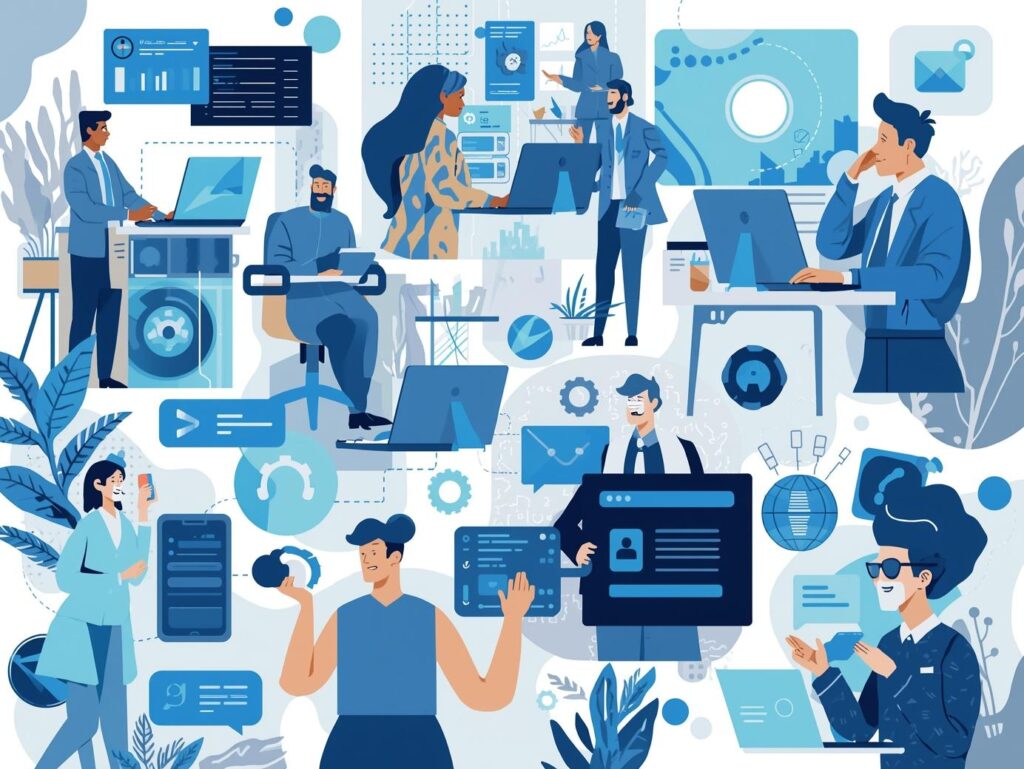
These tools provide summaries, categorize content, and recognize urgent tasks automatically, making it easier for employees to stay focused and informed.
Teams that adopt AI for information management often report reduced stress levels because they no longer feel buried under endless data streams. AI’s ability to simplify complexity is one of the strongest reasons it is becoming indispensable in digital work environments.
Corporate Adoption: Why Businesses Now See AI as Infrastructure
Not long ago, many companies hesitated to adopt AI due to concerns about cost, ethics, or technical challenges. But today, the landscape has shifted dramatically.
Businesses now recognize that failing to implement AI puts them at a competitive disadvantage. Organizations that adopt AI enjoy faster processes, better customer experiences, and more efficient operations. These benefits have encouraged companies to treat AI as essential infrastructure rather than optional technology.
Companies investing in AI governance, staff training, data management, and integration systems signal a deeper commitment. They’re no longer exploring AI—they’re building their entire future around it. AI adoption has moved from curiosity to strategy, becoming a foundational pillar of modern corporate development.
Workplace Well-Being: Reducing Stress Through AI Support
AI tools are not only improving productivity but also transforming workplace well-being. When employees no longer have to carry heavy cognitive loads or tackle tedious tasks alone, their stress levels decrease, and their mental clarity improves. AI acts like a supportive partner that helps shoulder responsibilities, making work feel more manageable. Over time, this improvement enhances morale, job satisfaction, and overall team performance.
Even workers who feared AI at first begin appreciating it once they experience the relief it brings. Instead of replacing human skills, AI complements them, allowing employees to work smarter, not harder.
AI Embedded in Everyday Tools: Seamless Integration into Workflows
AI is spreading everywhere—not just as a standalone system but as a built-in feature within most workplace platforms. From writing assistants in email clients to AI-driven insights in CRM systems, the technology is becoming invisible yet powerful.
This seamless integration removes obstacles because employees no longer need to switch apps or learn new systems. AI simply appears wherever they work, enhancing their efficiency without disrupting their routine.
Over time, this integration will deepen even further, turning AI from a tool people choose into a tool they naturally depend on. The ease and accessibility it provides ensure its continued rise in professional environments.
AI-Driven Decision Making: Guiding Strategy and Growth
AI’s role extends beyond task automation—it is now a key contributor to business decisions. Predictive analytics, risk assessments, customer insights, and market analysis all rely increasingly on AI systems that interpret data more quickly and precisely than human teams. Leaders use AI-generated insights to guide long-term planning, identify emerging trends, and mitigate risks. This capability strengthens strategic confidence and keeps organizations agile in fast-changing markets.
As these systems become more advanced, companies will rely on AI not just for operational tasks but for the very direction of their future.
Conclusion: AI Is Enhancing Work—Not Replacing It
AI tools are no longer novelties or optional technologies. They are becoming fundamental components of the modern workplace, elevating everything from productivity and creativity to collaboration and strategic planning. Instead of replacing human talent, AI amplifies it, helping individuals and teams reach new levels of performance. Companies that embrace AI thoughtfully are already seeing transformative improvements in efficiency, clarity, and innovation.
As we look ahead, the relationship between humans and AI will only deepen, fostering a work environment where technology supports our abilities rather than overshadowing them. AI is not the future—it is the present, and it is redefining what it means to work smarter in a fast-paced digital world.
1. Will AI eventually over-automate processes and reduce the need for human judgment?
AI will automate many routine tasks, but essential decisions will still require human judgment.
It enhances, not replaces, critical thinking by providing better data and insights.
The future will be a balance between automation and human oversight.
2. How can organizations balance productivity gains with ethical responsibility in AI usage?
Companies must set clear guidelines and monitor AI behavior to avoid misuse.
Regular audits, transparency, and accountability help maintain ethical standards.
Balancing efficiency with responsibility ensures safe and sustainable AI adoption.
3. What new skills must employees develop to remain competitive as AI expands?
Employees need stronger problem-solving, creativity, and critical thinking skills.
Basic understanding of AI tools will help them work more effectively alongside technology.
Adaptability and continuous learning will become essential in the evolving workplace.
4. How can companies maintain strong data privacy while scaling AI across departments?
Organizations must use secure storage, limit access, and protect sensitive data.
Regular audits and compliance checks strengthen privacy safeguards.
Clear policies and employee training ensure responsible data handling.
5. In what ways will AI reshape leadership roles, culture, and team structures?
Leaders will focus more on strategy and people development rather than task management.
Team structures will become more flexible and data-driven.
AI encourages a culture of learning, transparency, and digital collaboration.
6. Are businesses and employees prepared for long-term AI-dependent workflows?
Some companies are ready, but many are still catching up with training and adoption.
Employees vary in readiness, depending on skills and support provided.
Preparation is improving, but widespread readiness is still in progress.